Leader in the 2026 Gartner® Magic Quadrant™ for Intranet Packaged Solutions
12 Questions CHROs Should Consider Before Their Next Executive Meeting
Our new guide helps HR professionals and people leaders assess workforce sentiment, eliminate blind spots, and bring actionable data to leadership.

Lisa Ardill
Content Editor at Workvivo
When leadership asks, “How ready are our people for AI?”, what does your answer rely on?
Most HR teams point to login rates, tool provisioning counts, and training attendance figures. On paper, the rollout appears smooth. Yet beneath the surface, a familiar disconnect unfolds across teams. While 60% of employees believe AI can improve their work, nearly half worry generative tools will jeopardize their jobs.
When organizations focus entirely on technology selection rather than workplace culture, employee hesitation doesn’t vanish – it moves sideways into private chats, peer venting, and quiet resistance.
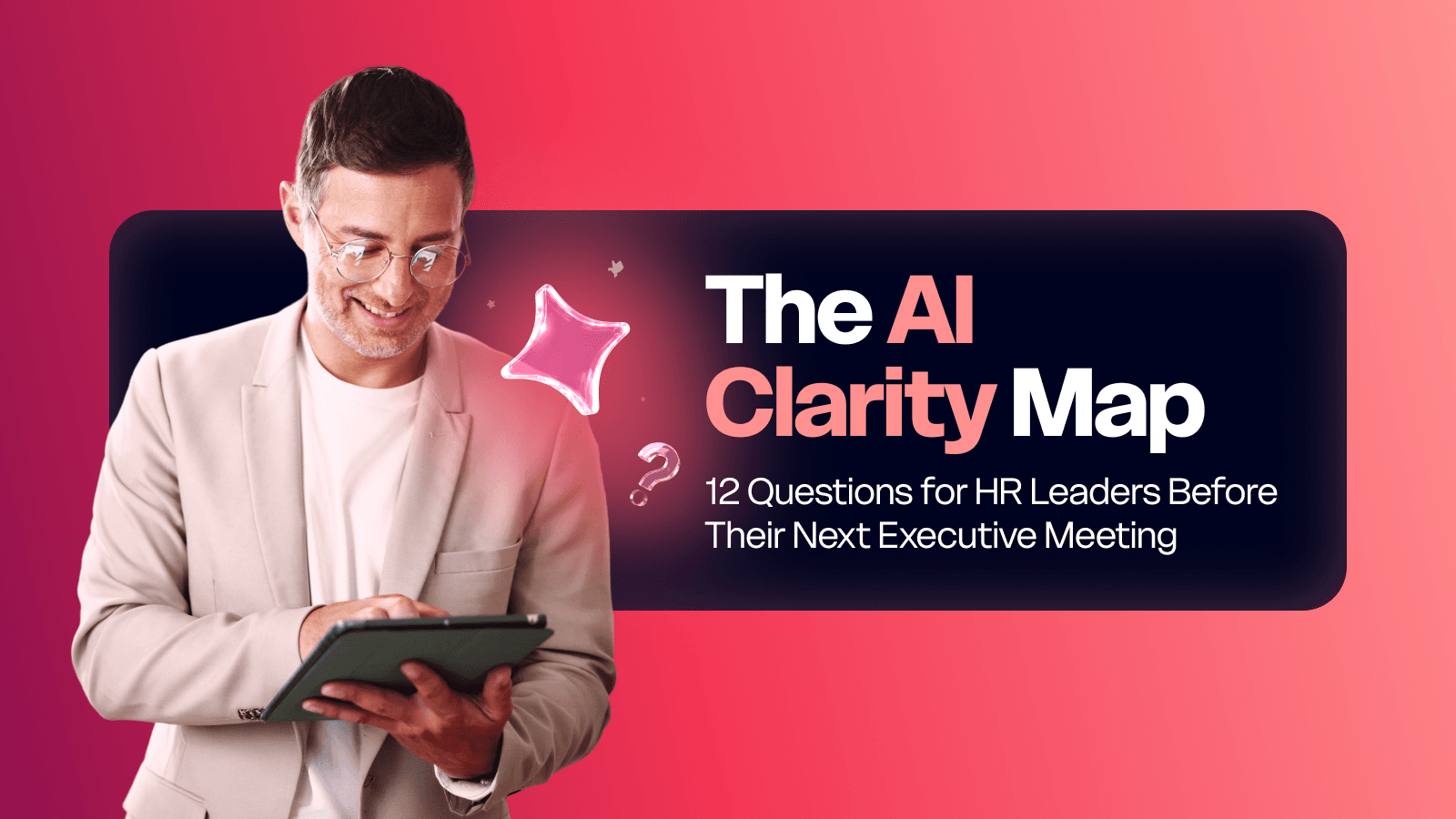
To help HR leaders bridge this critical divide, we’ve created The AI Clarity Map: 12 Questions for HR Leaders Before Their Next Executive Meeting. It’s an actionable assessment designed to evaluate workforce readiness, surface critical blind spots, and turn qualitative sentiment into strategic executive conversations.
Why standard metrics leave HR flying blind
Tracking who opened a tool or completed a video module doesn’t reveal how AI actually integrates into daily workflows. Today’s HR teams face four systemic challenges:
Adoption data lacks operational context
High login figures can easily mask employees spending hours editing subpar outputs or abandoning tools out of sheer frustration.
The frontline divide
While half of desk workers receive clear AI usage guidance, only 30% of frontline staff report the same support, leaving critical segments of the workforce unsupported and disconnected.
Surface-level surveys
Standard annual pulses group disparate concerns together, failing to distinguish between everyday operational friction, data security confusion, and genuine career anxiety.
Inaction fatigue
When employees voice valid concerns but see no subsequent operational changes or acknowledgments, trust erodes, and future feedback dries up entirely.
12 questions to diagnose your AI readiness
The guide walks through 12 targeted questions organized across four foundational themes:
- Employee sentiment and anxiety: Are you capturing nuanced feelings, or mistaking the opinions of a few vocal early adopters for widespread organizational buy-in?
- Adoption and inclusion: Are tools, documentation, and training centralized, practical, and truly accessible to deskless, shift, and non-desk workers?
- Listening infrastructure: Does your organization maintain closed feedback loops that visibly demonstrate how employee input shapes internal policy and workflows?
- Data, narrative, and executive credibility: Can you translate workforce signals into boardroom-ready insights before major procurement decisions are finalized?
Each question features a diagnostic prompt to evaluate where your visibility breaks down. Using the 36-point scoring framework, you can categorize your organization’s status.
Lead the AI conversation with confidence
HR professionals aren’t there to be brought in merely to manage change communications after procurement decisions are already signed and sealed. To guide your organization responsibly through technological disruption, you need continuous, representative workforce insight.
Download The AI Clarity Map today to evaluate your readiness, eliminate blind spots, and walk into your next executive briefing with answers grounded in proof.

Authors:
Lisa Ardill
Content Editor at Workvivo