LIVE SESSION: The Employee Listening Summit 2026: From Insight to Experience
Inside Virgin Voyages: How They Have Scaled Internal Comms on the High Seas
Learn how Virgin Voyages connects a global, 24/7 workforce through strong culture, visible leadership, and the leading employee engagement platform

Davin O'Dwyer
Head of Content at Workvivo
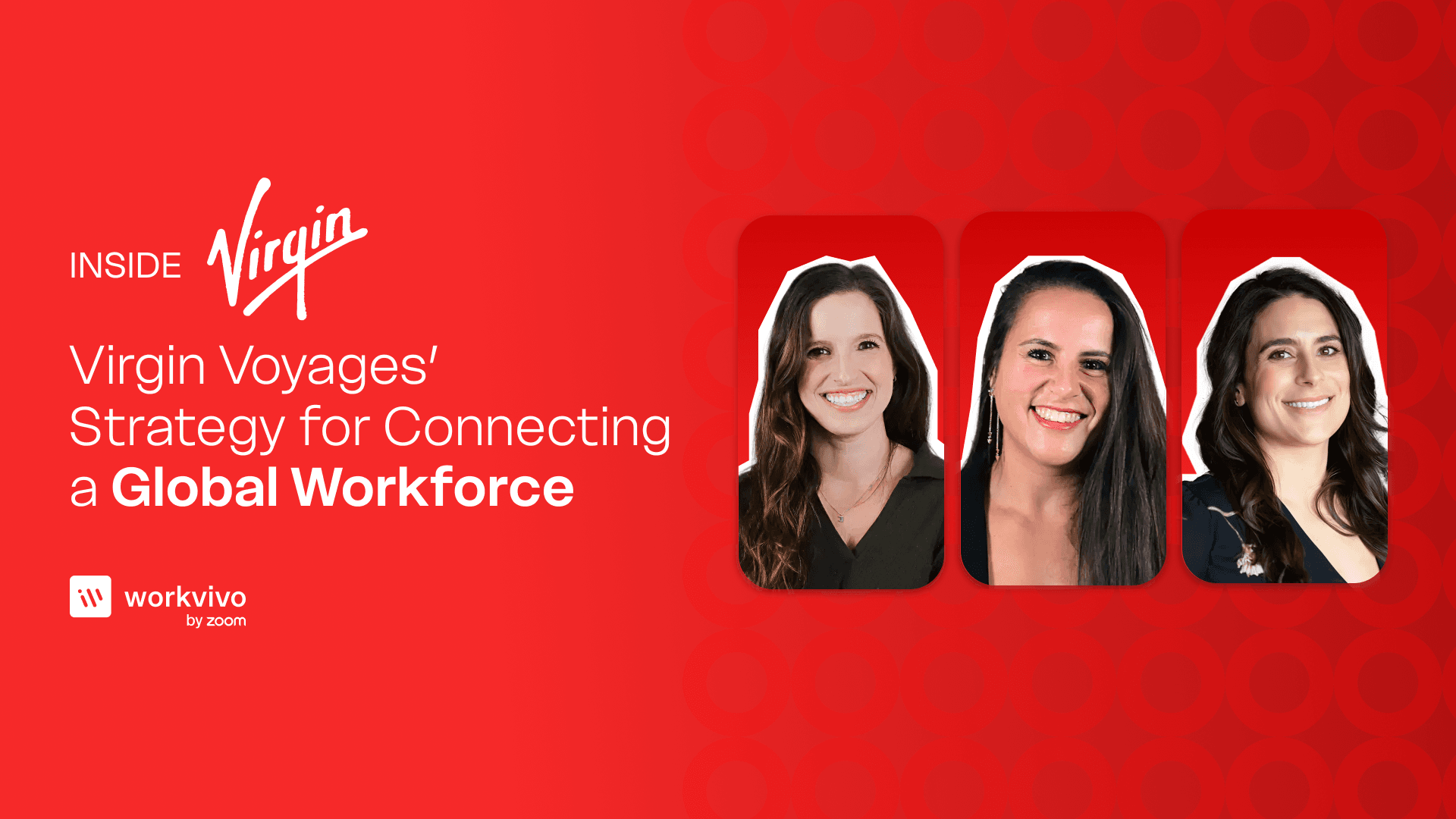
What does it take to create strong communication and real belonging in a business that operates across ships, shore teams, time zones, and more than 70 nationalities? That was the focus of this special live edition of The Comms Show, hosted by Barbara Booras from the Virgin Voyages headquarters in Miami, Florida.
Joined by Alaina Julia, Senior Manager of Internal Brand and Communications, and Paola Ortiz, Senior Manager of Crew (Employee) Experience, Barbara explores how Virgin Voyages brings its culture to life for a uniquely complex workforce.
We also went aboard the Scarlet Lady, one of Virgin Voyages’ signature vessels, to meet the crew and discuss what it’s like to run a floating city on the sea while maintaining a sense of community.
From frontline communication and leadership visibility to storytelling, recognition, and AI, the conversation offers a practical look at how internal comms can work at scale without losing its human touch.
Here are five standout takeaways from the discussion.
1. All hands on deck: Communication that reaches everyone
One of the clearest themes from the conversation was that communication at Virgin Voyages cannot be one-size-fits-all. The company operates ships across different regions, with crew members working around the clock in very different roles and contexts. A message sent at one time of day may land mid-shift for one crew member and during rest time for another.
That complexity means communicators have to think carefully about audience, timing, format, and urgency. Shore-based employees may be able to absorb longer, more narrative updates at their desks. Shipboard and frontline teams need faster, clearer formats that help them get what they need quickly and move on.
As Alaina put it, “One message may look six different ways depending on the audience.”
That mindset is a useful reminder for any internal comms team. Effective communication is not just about crafting the message. It is about shaping it for the environment in which people will receive it. The more operationally aware communicators are, the more relevant and useful their content becomes.
2. Belonging is the journey, not the destination
The most powerful part of the conversation was the emphasis on culture as something people can feel. Barbara reflects on seeing crew members arrive exactly as they are, without a rigid uniform standard or pressure to suppress their identity. That authenticity came through again and again in the crew interviews.
Paola describes the philosophy simply: “We take care of our people first, and then they take care of our customers.”
At Virgin Voyages, that principle shows up in visible ways. Crew members are encouraged to bring their personality, heritage, and style to work. Alaina explained that when people do not have to hide things like tattoos, hair, or other parts of their identity, they can be more present in the moment and create stronger connections with sailors.
That matters not only for employee experience, but for customer experience too – when crew members can be themselves, guests are more likely to see a piece of themselves reflected back. That creates a more relaxed, welcoming, memorable environment.
For internal communicators, the lesson is clear: belonging is not built through slogans alone. It is built through systems, signals, and daily choices that show people they are safe to show up fully.
3. Smooth sailing through waves of recognition
Recognition came up repeatedly throughout the event, from birthday celebrations and shout-outs on Workvivo to Virgin Voyages’ new “LegaSea” program, during which CEO Nirmal Saverimuttu honors crew members who have helped build the brand over time.
What stood out was how seriously the team takes these moments. Recognition is not treated as a nice extra. It is part of how Virgin Voyages reinforces pride, loyalty, and connection across a distributed workforce. Even small gestures matter. In the crew interviews, people spoke warmly about birthday posts, public praise, and those visible “ship ship hooray” moments that make employees feel seen.
Paola also highlighted the importance of listening. With crew members on different contract lengths, annual surveys are not always the best fit. The team is now rethinking its listening strategy to better match the employee lifecycle, gathering feedback at moments that are more relevant to the crew experience.
Alaina sums it up well: “It’s also advocacy and listening to our crew, which is a huge part of what our role is in internal comms and experience.”
That combination of recognition and listening is powerful. One tells people they matter. The other proves their voice matters too.
4. The bridge that connects ship and shore
Virgin Voyages uses Workvivo to create a central communication hub for its workforce. In a complicated digital landscape, that clarity matters. Not every crew member has a company email address, but everyone has access to Workvivo. That makes it the shared front door for communication, information, and connection.
The team uses different features in thoughtful ways: billboards for urgent visibility, chat for fast coordination, spaces for targeted audience updates, documents for reference materials, and events for building community. They have also created cues that help employees quickly distinguish between operational content and more social or optional updates.
Alaina explains, “Workvivo is the one stop that everybody has access to, no matter your title or position.”
That accessibility is what makes adoption possible. But the team also shares an important implementation lesson: adoption improves when you understand how each audience already works, then show how the platform makes life easier for them. In other words, start with user needs, not platform features.
For communicators, that is an important reminder. A platform becomes valuable when it reduces friction, creates consistency, and earns trust as the place people go first.
5. Setting sail for the future of comms
The final takeaway was about the future. Virgin Voyages is investing in more storytelling, more leadership access, and more thoughtful use of AI, but the through-line is clear: keep it human.
On storytelling, the Virgin Voyages team are excited about using video, podcasts, and day-in-the-life content to spotlight the many unique roles across the business. These stories help employees see the richness of the organization and feel proud of the brand they are helping to build.
Leadership visibility is also a major part of the culture. Barbara points to the approachability of CEO Saverimuttu, who shows up in person, hosts regular Q&As, and makes himself accessible to crew. This leadership style is deeply intentional and consistent.
Then there is AI. Rather than treating it as a replacement for people, Virgin Voyages is using it to remove repetitive work, support personalization, and strengthen planning. Alaina shares one especially practical use case for internal comms: using AI to take one core message and adapt it for different audiences, tone requirements, and comprehension needs.
As she puts it, “It really gives me the ability to take one message, put it in six different formats, and then start from there versus starting from scratch.”
That is a smart, grounded use of AI: not replacing judgment, but speeding up the work that helps communicators be more relevant and more responsive.
Culture on the ocean
This live episode of The Comms Show offers a strong example of what modern internal communication looks like when it is rooted in empathy, operational understanding, and culture by design. Virgin Voyages is proving that even in a literally fast-moving environment, it is possible to keep communication clear, leadership visible, and belonging at the center.
For internal communicators, there is plenty to take from this conversation: know your audiences deeply, build for access, recognize people often, and never lose sight of the human experience behind every message.
Authors:
Davin O'Dwyer
Head of Content at Workvivo