
Key takeaways
- An intranet serves as your company's private website for sharing news, policies, and documents, while a digital workplace encompasses all the tools employees use daily (from email to project management)
- Most organizations eventually need both a central communication hub and integrated tools, which is why the lines between these solutions keep blurring
- Company size and complexity drive the decision; smaller, simpler organizations can thrive with just an intranet, while distributed teams need comprehensive digital workplace solutions
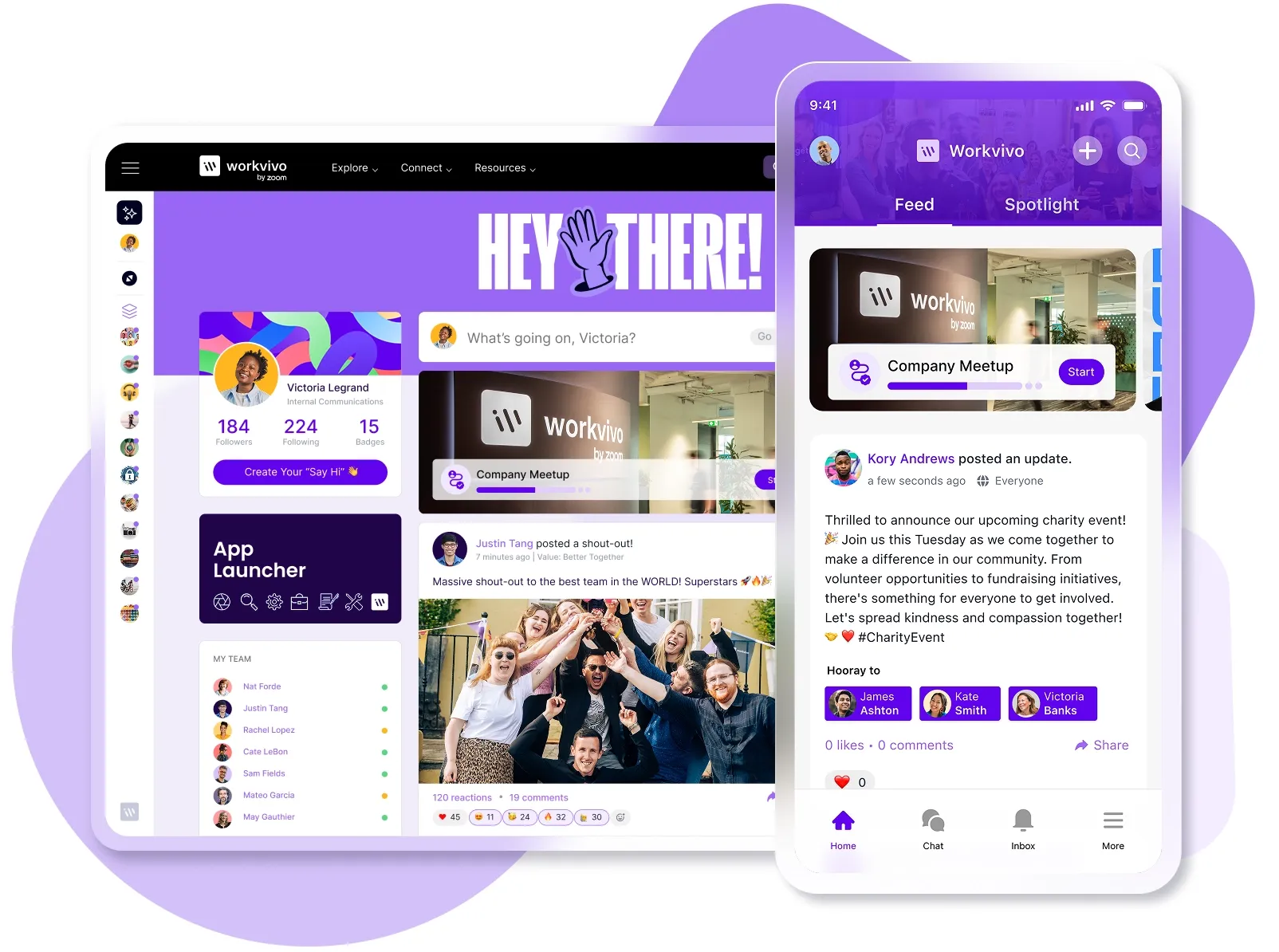
- Modern employee experience platforms offer a middleground by creating one social hub that connects to your existing tools without replacing them
The confusion between intranets and digital workplaces is understandable. One grew out of the other, and vendors often use both terms to describe the same products.
Think of an intranet as your company's private website. It’s a place to post news, store policies, and share documents.
A digital workplace, on the other hand, encompasses the entire collection of tools employees use to perform their jobs. That includes email, collaboration tools, video calls, project management, file sharing, and, yes, the intranet as well.
The difference might seem academic, but it determines whether you invest in a single platform or rebuild your entire tech stack.
What is an intranet?
A traditional intranet is a closed, private network that uses web browsers and internet technology to share information within a company.
Employees access it through their browsers using company credentials, and all the content (e.g., documents, pages, applications) is on servers that only your organization controls.
The core job of a traditional intranet is information distribution – news from leadership, HR policies, IT documentation, employee contacts, and any other content employees need but shouldn't be public.
That's the theory, anyway. Here's how one Reddit user breaks down what usually happens with the company intranet:
Let's be honest-most corporate intranets are digital ghost towns. A cluttered mess of outdated PDFs, a CEO blog that hasn't been touched in years, and a search function so broken it might as well be a prank.
An intranet should be the beating heart of your company's internal life. A tool beople want to use, not one they avoid like a bad cafeteria lunch. Yet, most companies build them for compliance, not for actual humans.
(Source: Reddit)
These problems come from how traditional intranets are built:
- IT-controlled updates that create content bottlenecks
- Search functions are notoriously bad
- No mobile optimization for remote or field workers
- No way for employees to interact, comment, or contribute
- They only mandate one-way communication (leaders post, employees read)
To combat these issues, newer intranets focus on employee experience with social feeds, mobile access, and employee engagement features – but more on that later.
What is a digital workplace?
A digital workplace is the complete digital environment where employees do their work. It's not a single platform or tool, but the entire ecosystem of technology your employees use every day.
This spans every category of workplace technology:
- Collaboration tools (Slack, Teams, Figma)
- Email (Outlook, Gmail)
- Meetings (Zoom, Google Meet, Webex)
- Documents (Google Workspace, Office 365, Dropbox)
- Project management (Monday, Asana, Jira)
- Business tools (Salesforce, HubSpot, Workday)
- The intranet (if you have one)
The key difference is scope. An intranet is your internal website for company content, whereas a digital workplace is the complete ecosystem of apps and tools.
One major problem with digital workplaces is that these tools pile up fast. One Reddit user describes where this leads:
I think the "digital workspace" will always be a victim of entropy. The number of tools always increases, there is little integration, and at some point you have so many tools only 5% of the users can remember which tool is used for what. The rest of the workforce just focuses on their favorites and ignores the others.
(Source: Reddit)
The tools multiply, and so do the problems. Employees check multiple apps every morning, copy data between systems that don't connect, and miss updates because they're spread across too many platforms.
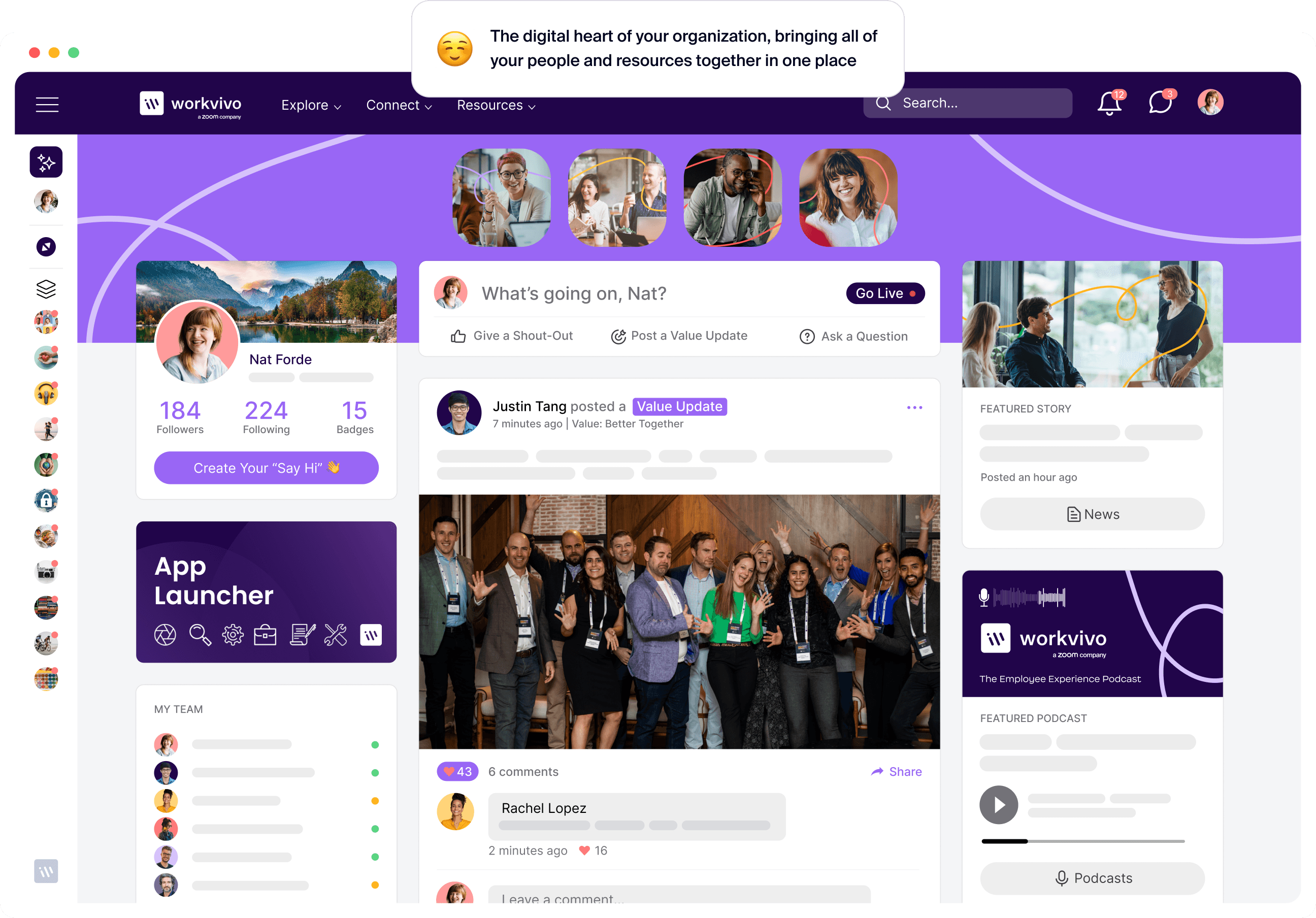
PRO TIP 💡: Employee experience platforms like Workvivo solve the tool overload problem by creating one social hub that connects to all your existing tools. Instead of checking ten different apps, employees start their day in one activity feed that pulls in updates, tasks, and notifications from across your digital workplace, all delivered through the same social interface they use on personal apps.
Comparing the two: Intranet vs. digital workplace
The line between intranets and digital workplaces blurs more each year as platforms become more sophisticated. To choose the right approach for your organization, you need to understand the core differences.
Here's how they compare today:
| Aspect | (Traditional) Intranet | Digital Workplace |
|---|---|---|
| What it is | A single platform that serves as your company’s private website | The complete collection of digital tools your employees use – from email to project management to HR systems |
| Primary purpose | Stores and shares company information, news, and resources | Employees can complete all their work digitally, from communication to collaboration |
| Scope | One system with defined boundaries | Your entire technology ecosystem (typically 20-50+ different tools) |
| What’s included | Company news, policy documents, employee directory, forms, and maybe basic forums | Everything: your intranet solution plus email, Slack/Teams, Zoom, project tools, CRM, HR systems, finance apps, and more |
| How communication works | Leadership posts updates, employees read them (mostly one-way) | Everyone communicates through multiple channels – chat, video, comments, emails (all directions) |
| Who creates content | Mainly HR, Internal Comms, and IT teams post official content | Every employee creates content across different tools all day long |
| User experience | Employees visit to find information when they need it | Employees actively work inside these tools for 8+ hours daily |
| Connects to other tools | Usually standalone, might link to email or calendar | All tools connect through APIs, single sign-on, and automated workflows |
| How search works | Searches only its own content – documents, news, people | More advanced platforms can search across all connected tools from one search bar |
| Mobile experience | Basic mobile site or simple app for viewing content | Full mobile versions of each tool, but it ultimately depends on the tech stack |
| Typical adoption | About 13% of employees use it daily, 31% never use it (Source) | Depends on the tool – 93% of users access their email daily, others vary widely (Source) |
| Number of vendors | One vendor provides the entire intranet platform | Multiple vendors – Microsoft for email, Slack for chat, Zoom for video, etc. |
| What implementation looks like | Deploy one platform, train employees once, launch | Coordinate dozens of tools, integrate systems, ongoing rollouts as you add tools |
| Biggest challenge | Employees don’t want to use it or don't see the value | Too many tools that don't connect to each other (tool fatigue and silos) |
Today’s digital workplace solutions include modern intranet features but reach across your entire technology ecosystem. So, it’s less about one platform and more about how all platforms work together.
When to choose an intranet vs. a digital workplace
Making the right choice depends on your organization's size, complexity, and work patterns. Let's break down when each solution makes sense.
When an intranet is enough
An intranet works perfectly when you want better communication without dealing with tool integration and multiple vendors.
Choose an intranet when you have:
- Fewer than 500 employees in mostly one location
- Simple communication needs (announcements, policies, procedures)
- Limited remote work or field workers who need easy access to information
- A tight budget that can'’t support multiple licenses
- Existing tools that work fine for collaboration (or minimal collaboration needs)
Example: A regional retail chain with 20 locations uses an intranet to keep store managers informed about promotions, policy changes, and inventory updates. Employees check it weekly for scheduling and company announcements.
Since stores operate independently and don’t need to collaborate on projects, the intranet handles all their communication needs.
When you need a modern digital workplace strategy
A digital transformation becomes necessary when your employees juggle multiple tools to get work done.
If your teams complain about switching between apps, losing information between systems, or not knowing where to find things, you’ve outgrown what a traditional intranet alone can provide.
Consider investing in a digital workplace when you have:
- Teams that collaborate across multiple departments and time zones
- Hybrid or remote workers making up more than 30% of your workforce
- Specialized teams using department-specific tools (developers on GitHub, sales on Salesforce)
- Information sitting in 10+ different systems
- Workflows that cross multiple platforms
- Compliance rules for data integration and audit trails
Example: A global consulting firm with 5,000 employees connects instant messaging platforms for internal communication, video conferencing for client meetings, project management tools for deliverables, and HR systems for timesheets.
Their digital workplace strategy focuses on single sign-on across all platforms and workflow automations that move data between systems. Consultants start their day in one dashboard that pulls tasks from multiple tools.
The hybrid approach (growing into a digital workplace)
Many organizations don't need to choose definitively.
Plenty of companies begin with an intranet to fix communication problems, and then layer in project tools and integrations later as teams grow more sophisticated.
Here are some of the signs that you’re ready to expand:
- Employees copy-paste the same data into multiple systems every day
- Teams miss important updates because they work in different tools
- New employees need weeks to figure out which tool does what
- Your IT team spends half its time moving data between platforms
- Managers check five different dashboards to understand what’s happening
- People email files because sharing them properly takes too many steps
If you’re seeing these issues, you’ve outgrown a basic intranet. You need a platform that integrates your tools but maintains the central communication space employees rely on.
PRO TIP 💡: It’s cheaper to build right than rebuild later. Platforms like Workvivo come with 40+ integrations already built in, so companies avoid the consultant fees and custom development costs of connecting disparate tools down the road.
Quick assessment: Are you ready for more than an intranet?
Not sure which path makes sense? Score yourself on these real workplace scenarios.
| Question | Yes = 2 points | Maybe = 1 point | No = 0 points |
|---|---|---|---|
| Do you waste more than two hours per week searching for information or answering repeated questions? | |||
| Do employees constantly miss updates because they're buried in email or Slack? | |||
| Do you have someone who can dedicate at least five hours per week to platform governance? | |||
| Are employees in different locations/departments operating like separate companies? | |||
| Is your leadership willing to actively use and promote a new platform? | |||
| Do you have a budget for both the platform AND proper training/implementation? |
Scoring:
- 10-12 points: Strong candidate for a digital workplace solution 🟢
- 6-9 points: An intranet could help, but plan for expansion 🟡
- 0-5 points: Focus on fixing foundational issues first 🔴
The best of both: How employee experience platforms bridge the gap
The workplace technology journey started simple. Companies built intranets in the 1990s to share information. Then came the explosion of SaaS tools, and suddenly everyone had their favorite app for everything.
This created digital workplaces, but also brought “franken-stacks”.
Now, we're seeing a third wave – employee experience platforms (EXPs) that give you one social hub for company communications while connecting to all your existing tools through simple integrations.
Here’s what makes them different:
- Social features from consumer apps: EXPs copy the social media experience employees already know. People post updates, share wins, and recognize colleagues just like they do on personal apps. Workvivo hits 85%+ adoption rates because employees don’t need any formal training or onboarding.
- Integration without overwhelming complexity: Most EXPs seamlessly connect to Microsoft 365, Slack, and your other tools through APIs. Employees get one place to start their day, with single sign-on to everything else.
- They’re built for how people work today: Mobile-first design means frontline workers get the same digital experience as desk employees. With AI-powered tools, they can bring up relevant content instead of making people search.
- Cross-generational workforces find common ground: Younger employees get the social features they expect. Older workers get the structure and search they need. Everyone uses the same platform differently, but successfully.
- Remote and hybrid teams finally get a virtual headquarters: Remote workers don’t feel disconnected from the work environment anymore because they see what’s happening across the company through activity feeds, live events, and peer updates.
Why companies switch to EXPs (case study)
TELUS International, a global IT services company with 66,000 employees across 26 countries, needed to unite its hybrid workforce after years of using multiple disconnected collaboration platforms.
Before Workvivo, their teams used different tools across regions – some on internal systems, others on various social platforms. Remote and hybrid employees felt disconnected from company culture, and leadership struggled to reach frontline staff with important updates.
The company knew they needed one platform to bring everyone together, but previous attempts at internal communication tools saw adoption rates below 20%.
With Workvivo, TELUS International created a true digital headquarters where all employees (from IT specialists to customer service teams) connect daily through social feeds, live events, and peer recognition.
The results speak for themselves:
- 92% of employees actively use the platform
- 87% feel more connected to the organization
- 87% report improved real-time leadership visibility and trust
- 70% of staff log in through mobile devices
- 75,000+ peer recognition posts in the first year
Workvivo's answer to the modern workplace challenge
The choice between an intranet and a digital workplace platform doesn't have to be an either/or decision.
Most companies need elements of both – the communication hub of an intranet and the integrated ecosystem of a digital workplace.
The problem is that building both separately creates complexity, cost, and confusion for employees who just want to get work done.
That's where Workvivo comes in.
Workvivo is an employee experience platform that consolidates internal communications, peer recognition, and workplace tools into a unified social hub built for both desk and frontline workers.
Here’s exactly what you’ll get with Workvivo:
- Mobile access for frontline workers: Every feature works on mobile, not just a stripped-down version. Frontline workers check updates during commutes, managers approve requests from the field, and remote employees stay connected to company culture.
- Spaces that create micro-communities: Teams, departments, and interest groups get their own spaces to collaborate and share knowledge. Corporate spaces handle official communications while community spaces let employees create their own groups for everything from new parents to Python developers.
- Social feed that works like consumer apps: Employees post updates, share wins, and recognize colleagues through the same interface design they use on personal social platforms.
- Integration hub for your existing tools: Workvivo connects to 40+ platforms, including Microsoft 365, Google Workspace, Slack, and your HR systems. Employees start their day in Workvivo and launch into other tools through single sign-on.
- Recognition that connects to company values: Employees give peer recognition through badges, awards, and kudos that managers can track through analytics dashboards. The platform even integrates with Workday to add recognition directly to performance records.
Instead of choosing between communication and integration, you get both in a platform built for how people work today.
Schedule a demo and see why employees check Workvivo before their actual email.